

One of the biggest barriers to getting addiction treatment is cost. If you don’t have insurance or you’re worried about how to pay for intensive outpatient programs, medication-assisted treatment, or other addiction services, you might think you’re out of options.
You’re not.
In Delaware, state-funded treatment is available through DSAMH (Delaware’s Division of Substance Abuse and Mental Health). This means you can access intensive outpatient programs, counseling, medication-assisted treatment, and other services at little to no cost.
This guide explains how DSAMH funding works, who qualifies, how to access it, and what other payment options are available at CORAS Wellness in Delaware.
What Is DSAMH and How Does It Work?
DSAMH stands for the Division of Substance Abuse and Mental Health. It’s the state agency within Delaware’s Department of Health and Social Services responsible for funding addiction and mental health services for Delaware residents.
DSAMH funding comes from state and federal grants, including the Substance Abuse Prevention and Treatment Block Grant from the federal Substance Abuse and Mental Health Services Administration (SAMHSA).
The program is designed to ensure that cost is never a barrier to getting help for substance use disorders.
Key Facts About DSAMH Funding
- It’s not a loan. You don’t pay it back. There’s no bill sent to you later. There’s no repayment plan or debt.
- It covers comprehensive addiction treatment. DSAMH pays for screening, intake assessment, counseling, group therapy, intensive outpatient programs, medication-assisted treatment, case management, and more.
- It’s available at CORAS. We accept DSAMH funding at all our Delaware locations. We have staff members whose job is to help you navigate the funding process.
- Authorization is faster than insurance. With insurance, we typically wait about a week for authorization. With DSAMH, you can often start treatment immediately.
Who Qualifies for DSAMH Funding?
DSAMH funding is primarily available to Delaware residents who are uninsured. Here’s what you need to qualify:
Primary Eligibility: Uninsured Delaware Residents
- You don’t have health insurance. If you’re uninsured and struggling with substance use, you qualify for DSAMH-funded treatment services.
- You’re a Delaware resident. You need to live in Delaware to access DSAMH-funded services.
- You need substance use disorder treatment. You’re seeking help for drug or alcohol addiction.
There’s no income requirement. There’s no asset test. You don’t need to provide tax returns or bank statements. The main criterion is that you’re a Delaware resident who needs addiction treatment and doesn’t have insurance coverage.
What About People With Insurance?
If you have insurance, CORAS will work with your insurance company to get authorization for treatment. Most insurance plans cover IOP, outpatient counseling, and medication-assisted treatment.
If your insurance denies authorization or won’t cover the services you need, the situation becomes more complex. DSAMH has specific programs for individuals with “limited insurance coverage,” but these typically require meeting additional clinical criteria for severe and persistent behavioral health disorders.
During your intake at CORAS, our team will assess your situation and help you understand what coverage options are available to you. If your insurance won’t cover treatment, we’ll work with you to find a solution.
What Services Does DSAMH Cover?
DSAMH funding covers a wide range of addiction treatment services at CORAS Wellness:
Intensive Outpatient Programs (IOP)
Nine hours per week of structured group therapy, individual counseling, drug testing, and recovery support. The full 12-week program is covered. Learn more about IOP programs at CORAS.
Outpatient Counseling
Individual therapy sessions with a licensed counselor, case management, and ongoing support as you work on your recovery goals.
Medication-Assisted Treatment (MAT)
This includes methadone, Suboxone, and Vivitrol. The medication itself, dosing at the clinic, nursing support, and counseling are all covered. As you progress in treatment, you may also qualify for methadone take-home privileges.
Mental Health Services
If you have co-occurring conditions like depression, anxiety, or bipolar disorder alongside substance use, psychiatric evaluations and medication management are covered.
Case Management
Help with housing referrals, employment support, and navigating legal or child welfare systems. Case managers connect you with community resources you need to support your recovery.
Drug Testing
Required as part of IOP and MAT programs to monitor progress. Testing helps clinicians understand if treatment is working and if adjustments are needed.
Transportation Assistance
For some clients, transportation to and from the clinic can be arranged through services like Modiv Care. Transportation should never be a barrier to attending treatment.
The goal is to remove every barrier to treatment. If you need help, DSAMH funding makes it accessible.
How to Access DSAMH-Funded Treatment
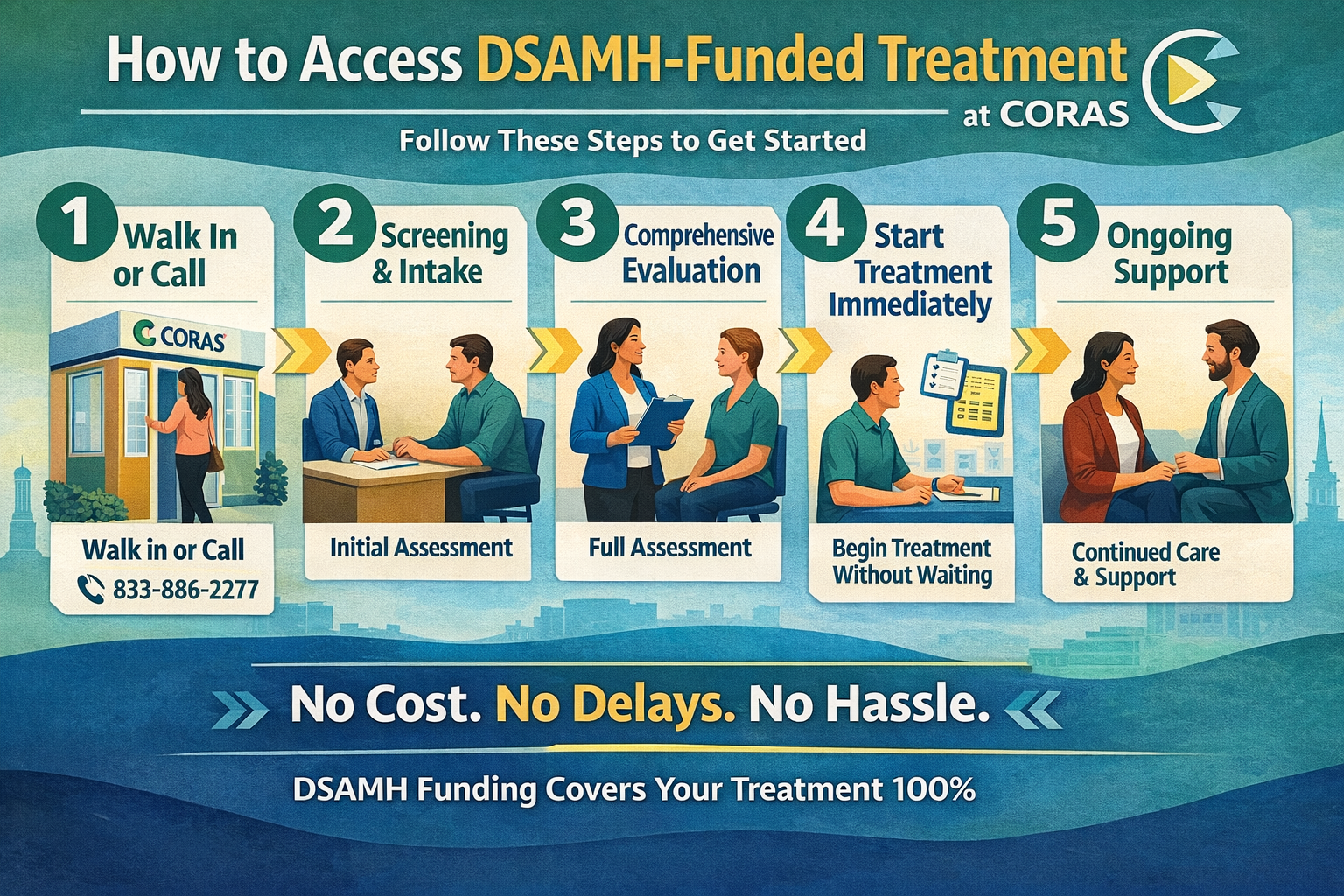
Getting started with DSAMH-funded treatment is straightforward. Here’s the step-by-step process:
Step 1: Walk In or Call for Intake
You don’t need a referral from a doctor. You don’t need to fill out complicated applications ahead of time. Just show up or call.
Walk in: CORAS offers walk-in intakes Monday through Friday before 10:00 a.m. at all our Delaware locations: Dover, Newark, Harrington, Millsboro
Or call: You can also call our intake hotline at 833-886-2277 to schedule an appointment if you prefer, but it’s not required
Step 2: Screening and Intake Assessment
When you arrive, you’ll meet with one of our counselors. We’ll do a brief screening to determine what level of care is appropriate for your situation.
Maybe it’s intensive outpatient (IOP). Maybe it’s regular outpatient counseling. Maybe it’s medication-assisted treatment. We’ll figure out what you need based on your substance use, mental health, housing situation, and other factors. At this point, we’ll also confirm your insurance status. If you don’t have insurance, we’ll let you know that DSAMH funding is available to cover your treatment.
Step 3: Comprehensive Biopsychosocial Assessment
One of our counselors will conduct a full biopsychosocial assessment. This looks at:
Your substance use history (what you’re using, how much, how often, for how long), Mental health conditions, Physical health needs, Housing situation and stability, Employment status
Legal involvement (probation, pending charges, child welfare cases), Support system (family, friends who support your recovery). This assessment takes time, but it’s essential. It drives your individualized treatment plan and helps us understand what services you need to succeed.
Step 4: Start Treatment Immediately
Here’s the big difference between DSAMH funding and insurance authorization:
With insurance: We submit a request to your insurance company and wait about a week for approval. Then you can start treatment.
With DSAMH: There’s no authorization process. You can start immediately. If you came in on a Tuesday for intake and you need IOP, you could start the next day, Wednesday.
No waiting. No denials. No bureaucracy standing between you and treatment.
Step 5: Ongoing Support Throughout Treatment
Once you’re in treatment, DSAMH continues to cover your services for as long as you need them.
If you’re in a 12-week IOP program, DSAMH pays for all 12 weeks. If you’re on methadone for months or years, DSAMH continues to cover your medication and counseling.
You won’t receive a bill in the mail. If you do receive a bill by mistake, bring it to the clinic and we’ll resolve it. DSAMH-funded treatment means no cost to you.
What If You’re Homeless or Don’t Have Stable Housing?
Homelessness is not a barrier to treatment at CORAS.
DSAMH funding is available regardless of your housing situation. If you’re staying in a shelter, living in your car, couch-surfing with friends, or sleeping outside, you can still access treatment.
In fact, our case managers can help you find stable housing while you’re in treatment. We work with recovery houses, transitional housing programs, and other resources throughout Delaware. Getting you into treatment and getting you into safe housing often go hand in hand.
We worked with a woman who entered our program while pregnant. She was struggling with crack cocaine addiction, facing homelessness, and missing OB/GYN appointments. Through consistent treatment, mental health support, and a referral to a recovery house in southern Delaware, she got stable. She had a healthy baby. She became the house manager at her recovery residence. She’s approaching a year clean.
That kind of transformation doesn’t happen because of funding alone. It happens because funding removes the financial barrier so treatment can do its work.
How CORAS Wellness Handles DSAMH Funding
At CORAS, we make DSAMH funding as simple as possible for clients. Here’s what we do:
- We verify your eligibility. During intake, we confirm that you’re a Delaware resident and that you don’t have insurance. That’s it. No complicated paperwork on your end.
- We handle the billing. We submit the necessary documentation to DSAMH. You don’t need to deal with any administrative processes.
- We don’t send you a bill. If DSAMH is covering your treatment, you won’t receive a bill. If you do receive one by mistake, bring it to us immediately and we’ll take care of it.
- We provide the same level of care. DSAMH-funded clients receive the exact same services as clients with private insurance. Same counselors. Same groups. Same medication. Same quality of care.
There’s no stigma. There’s no second-tier treatment. You’re a client, and we’re here to help you recover.
Other Payment Options at CORAS Wellness
If you don’t qualify for DSAMH funding because you have insurance, CORAS accepts several forms of payment:
Delaware Medicaid
This includes Delaware First, Highmark, and Amerihealth Caritas managed care plans. Most addiction treatment services are covered at no cost to you. Prescription co-pays for medications may apply but are usually minimal.
Medicare
Covered for eligible clients age 65 and older or those with qualifying disabilities.
Commercial Insurance
We accept most employer-based insurance plans, including Aetna, Cigna, United Healthcare, Blue Cross Blue Shield, and others. Authorization usually takes about a week. Your out-of-pocket costs depend on your specific plan’s deductible and co-insurance.
Self-Pay
If you don’t have insurance or DSAMH funding and you want to pay out of pocket, we can discuss payment arrangements. Contact our intake team to learn more about self-pay rates.
The bottom line: we will find a way to get you into treatment. Cost should never be the reason you don’t get help.
Common Questions About DSAMH Funding
How long does DSAMH funding last?
As long as you need it and continue to meet eligibility criteria. If you’re in a 12-week IOP program, DSAMH covers all 12 weeks. If you’re on methadone for a year, DSAMH covers it for a year. There’s no predetermined cap or time limit.
What happens if I get insurance while I’m in treatment?
If you gain insurance coverage while you’re receiving DSAMH-funded treatment, we’ll transition your billing to your insurance company. You’ll continue treatment without interruption. We’ll handle the administrative transition.
Can I use DSAMH funding at any treatment center in Delaware?
DSAMH funding is available at approved providers throughout Delaware. CORAS Wellness is one of the largest DSAMH-approved providers in the state. Not all treatment centers accept DSAMH, so it’s worth asking before you go for intake.
What if I’ve been to treatment before and it didn’t work?
Past treatment attempts don’t disqualify you from DSAMH funding. Recovery rarely follows a straight line. Many people need multiple treatment attempts before finding what works for them. You’re still eligible for DSAMH-funded services.
What if I have a job and income?
Having a job doesn’t disqualify you from DSAMH funding. The main criterion is whether you have health insurance. If your employer doesn’t offer insurance or you can’t afford the premiums, DSAMH funding is available for uninsured Delaware residents regardless of employment status.
Do I need to be a U.S. citizen to qualify for DSAMH?
You need to be a Delaware resident. Citizenship status requirements may vary depending on specific circumstances. Our intake staff can answer questions about your specific situation during your assessment.
Why CORAS Wellness Works With DSAMH
At CORAS, we believe that every person deserves access to quality addiction treatment regardless of their ability to pay.
DSAMH funding makes that possible. It allows us to serve people who would otherwise go without treatment. It removes the financial barrier so people can focus on recovery instead of worrying about bills.
We work with DSAMH because we’ve seen what happens when cost isn’t an obstacle. People show up. They engage in treatment. They make progress. They rebuild their lives.
We’ve worked with clients who had nothing. No insurance. No stable housing. No support system. They walked through our door, got connected to DSAMH-funded treatment, and everything changed. Treatment was financially accessible. Funding wasn’t a barrier. Someone took the first step, and their life transformed.
If You’re Ready to Start Treatment
If you’re uninsured and you need addiction treatment in Delaware, here’s what you do:
Walk into one of our clinics Monday through Friday before 10:00 a.m.:
Or call our intake hotline: 833-886-2277
Tell our staff that you don’t have insurance. We’ll take care of the rest.
DSAMH funding will cover your treatment. You can start immediately. Within a day or two, you can be in your first IOP session, your first counseling appointment, or receiving your first dose of methadone.
You don’t have to have it all figured out. You don’t have to have money saved. You just need to take the first step.
There’s help available. There’s funding available. There’s a whole team of people who want to support your recovery. But you’ve got to walk through that door or pick up that phone.
Recovery is possible. Treatment is accessible. And you deserve a chance at something better.
For more information about our IOP programs, MAT services, or residential treatment options, contact CORAS Wellness today.
